

How To Glue Up a Coopered Panel


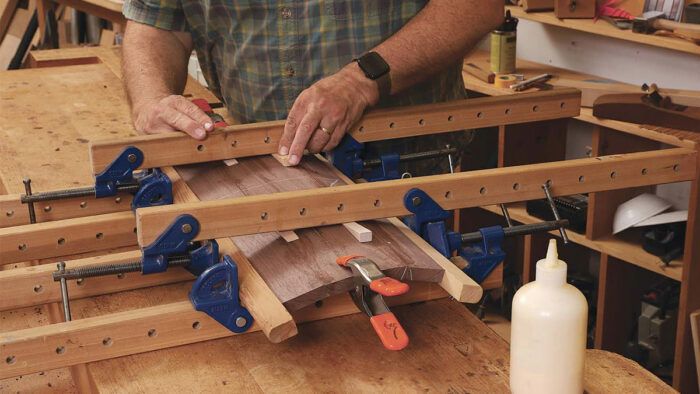
Gluing curved workpieces can be frustrating because their shape makes it challenging to achieve even pressure across the entire surface. As a result, woodworkers often need to devise creative solutions, such as using flexible clamps or applying glue in stages, to ensure a strong bond. Craig Vandall Stevens does both as demonstrated below.
Two staves at a time

Do separate glue-ups for each pair of staves. Stevens uses cauls that have rounded outer edges; when clamping pressure is applied, each caul naturally angles upward, maintaining full contact with the edge of its stave.
A pair of pairs

With the first two pairs of staves cured, glue them together to make the full door.
Contain the curve

The higher the curve, the greater the tendency for clamp pressure to pop the seam open on top. To counteract this, Stevens adds clamps across the top and presses wedges underneath them. He uses light pressure on all the clamps.
DIY bar clamps

Stevens swears by his Record “sash clamps,” which he’s been using for 30 years. He loves how light, flat, stable, and powerful they are. You buy the heads and make the bars yourself. He made his with poplar and waxes them to resist glue. Record brand clamps are available from European suppliers.
This is an excerpt from Krenov-Inspired Coopered Wall Cabinet by Craig Vandall Stevens, featured in Fine Woodworking #319

Krenov-Inspired Coopered Wall Cabinet
Fine Woodworking Recommended Products
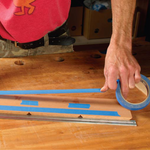
3M Blue Tape
One of the most versatile accessories to have in the shop: from layout to seaming veneer. It has enough stretch to pull joints together.
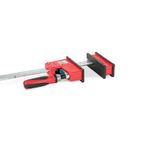
Bessey K-Body Parallel-Jaw Clamp
The 3 3/4″ deep parallel jaws allow for all types of clamping, from thin panels to joinery.
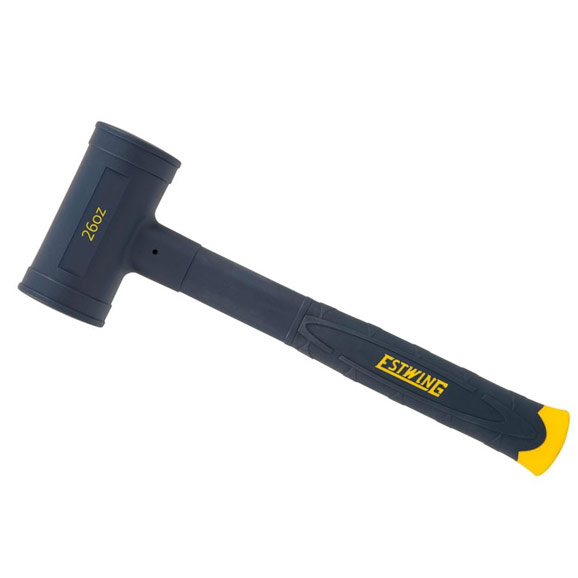
Estwing Dead-Blow Mallet
A quality dead-blow mallet that packs and punch but isn’t too heavy for furniture work.
Sign up for eletters today and get the latest techniques and how-to from Fine Woodworking, plus special offers.